
English| EUR
Suggested for you
More currencies
Choose a language
Morro de São Paulo sits on Tinharé Island, twenty-five kilometers offshore from the Bahian coast. No bridge connects it to the mainland, and no cars cross its shore — every arrival begins with a conscious choice of vessel or flight. The route from Salvador to this car-free village demands coordination between terminals, timetables, and the tidal logic of the Bay of All Saints.
Quick answer
Reaching Morro de São Paulo from Salvador requires either a catamaran from Terminal Marítimo (two hours), a conventional ferry from Terminal São Joaquim to Bom Despacho followed by a van and boat transfer (three to four hours total), or a charter flight from Salvador's airport (twenty-five minutes). The catamaran is the most direct option for most travelers, departing daily between 09:00 and 14:30 depending on season and operator. Once you arrive, a conservation fee of 70 BRL per person is collected at the village landing.
No road crosses the water between Salvador and Tinharé Island. Every traveler who steps onto the sand of Morro de São Paulo has made the same crossing — by boat, by plane, or by a hybrid route that strings together ferry, van, and launch. The village itself enforces a car ban, so the transfer is not simply logistical theater; it is the threshold that separates the city from an island economy built on foot traffic and wheelbarrows. Understanding how to get to Morro de Sao Paulo from Salvador begins with recognizing that three distinct routes exist, each trading time against cost and comfort. The catamaran departs from Terminal Marítimo in the commercial heart of Salvador and makes a direct open-water crossing to the island's main pier in approximately two hours. It is the fastest conventional option and the one most independent travelers choose. The conventional ferry route requires more patience: passengers board at Terminal São Joaquim, cross to Itaparica Island at Bom Despacho, transfer to a waiting van that drives south to Valença, then board a smaller boat for the final crossing to Morro. The entire sequence spans three to four hours depending on connection windows. Charter flights from Salvador's domestic terminal cut travel time to twenty-five minutes but cost five to eight times the price of the catamaran and operate only when passenger loads justify the flight. The Bay of All Saints imposes rhythm on all three routes. Catamaran schedules shift with the season — more frequent departures appear during Carnival, Réveillon, and the July school holidays, while off-peak months see reduced service. Ferry and van transfers depend on the coordination of multiple operators, and delays compound across each leg. Flight availability fluctuates with demand, and weather conditions over the bay can ground small aircraft without notice. Most travelers arriving in Salvador book the catamaran at least one day in advance to secure a morning departure, which delivers them to the island before midday heat peaks and allows time to settle before the afternoon ferry crowds arrive. The village levies a 70 BRL conservation fee upon arrival, collected at a booth steps from the catamaran pier. This fee funds trail maintenance, waste collection, and beach monitoring across the island. No ticket booth exists for Morro de São Paulo itself — the destination is open every day of the year, accessible whenever a vessel or aircraft is willing to make the crossing. The best arrival window falls between 08:00 and 11:00, when the beaches are quieter, the sun is still angled low, and the guest houses have finished turning over their rooms. Plan the transfer route from Salvador with that window in mind, and the island greets you on its own terms rather than at the peak of its daily churn.
“No road crosses the water between Salvador and Tinharé Island — every arrival begins with a vessel or a flight.”
Morro de São Paulo is located on the island of Tinharé in the municipality of Cairu, Bahia. Access from Salvador is exclusively via maritime or intermodal transport.
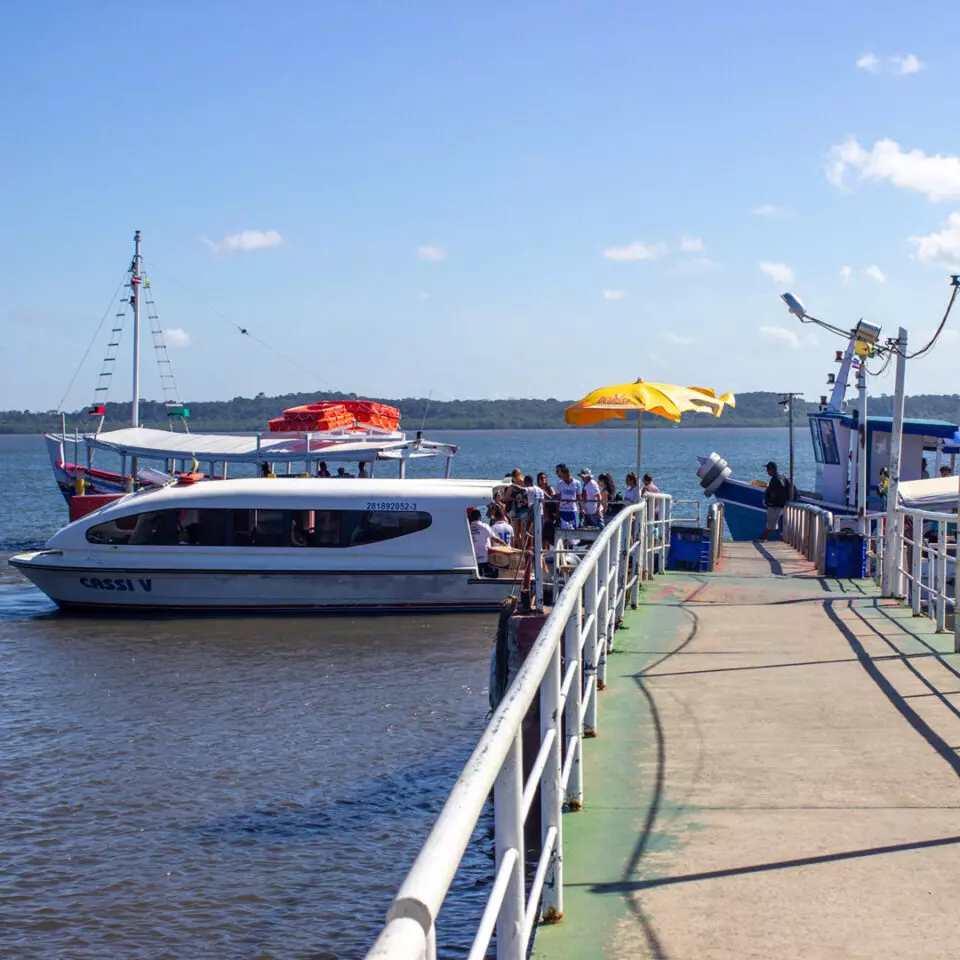
Catamaran from Terminal Turístico Náutico da Bahia to Morro de São Paulo
Speedboat from Terminal de São Joaquim to Itaparica, followed by bus to Valença and ferry to Morro
From the Morro de São Paulo arrival pier to local accommodation
Upon arrival at the pier, visitors must proceed to the tourist checkpoint to handle local requirements. Porter services with wheelbarrows are available at the dock for transport to accommodations, as motorized vehicles are restricted on the island.
The best arrival window is 08:00–11:00 to avoid midday heat and enjoy quieter beaches before peak ferry arrivals. Planning your travel around these hours ensures a more relaxed transition to the island.
Warm, 24°C to 28°C, low rain
These months offer balanced weather and fewer travelers compared to peak summer. It is an ideal period for consistent sea conditions and manageable crowds.
Hot, 26°C to 30°C, humid
Expect larger crowds and frequent ferry arrivals during this peak summer season. High temperatures require careful planning for outdoor activities.
—
Arriving during weekday mornings helps avoid the congestion caused by weekend tourists. This provides a calmer experience when navigating local arrivals.
Verdict: The best arrival slot is weekday mornings between 08:00–11:00 during the months of September, October, or November.
Prepare these items before departure to ensure a smooth arrival at Morro de São Paulo.
Morro de São Paulo is accessible to visitors throughout the entire week. The destination maintains continuous operational access for arrivals regardless of the day.
Everything you need to know about how to get to morro de sao paulo from salvador
Travelers typically depart from the maritime terminal near the Mercado Modelo in Salvador. You can choose between catamaran services or a combination of land and sea transfers to reach the island. This is the most common way to get to morro de sao paulo from salvador for visitors staying on the island.
Visitors must be aware of the TUPA conservation fee collected upon arrival. This payment is mandatory for all non-resident tourists visiting the village. Ensure you have the local currency ready for this process once you land.
The best arrival window is between 08:00 and 11:00. Arriving during this period helps you avoid the midday heat and enjoy quieter beaches before the peak ferry arrivals. Planning your travel around this time improves your overall experience.
Catamarans are a frequent method for how to get to morro de sao paulo from salvador, taking you directly across the bay. These vessels depart regularly from the terminal in the city center. It is advisable to book your transit in advance to secure your preferred departure time.
Yes, an entrance fee of 70 BRL is required upon arrival as the TUPA conservation fee. This amount is collected from each person to support local infrastructure and environmental preservation. Please have this fee prepared when you disembark at the pier.
Transfers can be arranged via boat or small aircraft, depending on your budget and time constraints. While boats remain the standard option for how to get to morro de sao paulo from salvador, flights provide a faster alternative. Both methods require pre-booking to ensure availability during peak travel periods.
While ferry services operate daily, weather conditions can occasionally impact maritime schedules. Regardless of the season, checking the maritime conditions is a smart step when learning how to get to morro de sao paulo from salvador. We recommend reviewing travel updates before heading to the maritime terminal.